389 decisions · 15 threads × 18 phases · verified July 2026
Go from one-shotting demos to shipping a complete app.
Your agent can build the first 20 minutes of an app by itself. The masterclass is the other 389 decisions — stack, auth, payments, launch — in order, with verdicts your agent can hold to from empty repo to release.
You don’t have to become the senior engineer. You don’t need to have shipped three apps already to get this one right. Even if you’ve never shipped anything past localhost.
If you’re a smart builder shipping a mobile or desktop app with an AI coding agent, the masterclass gives you and your agent the questions, the verdicts, and the reasoning from day one.
CURRENT AS OF · July 2026 · check the sources →
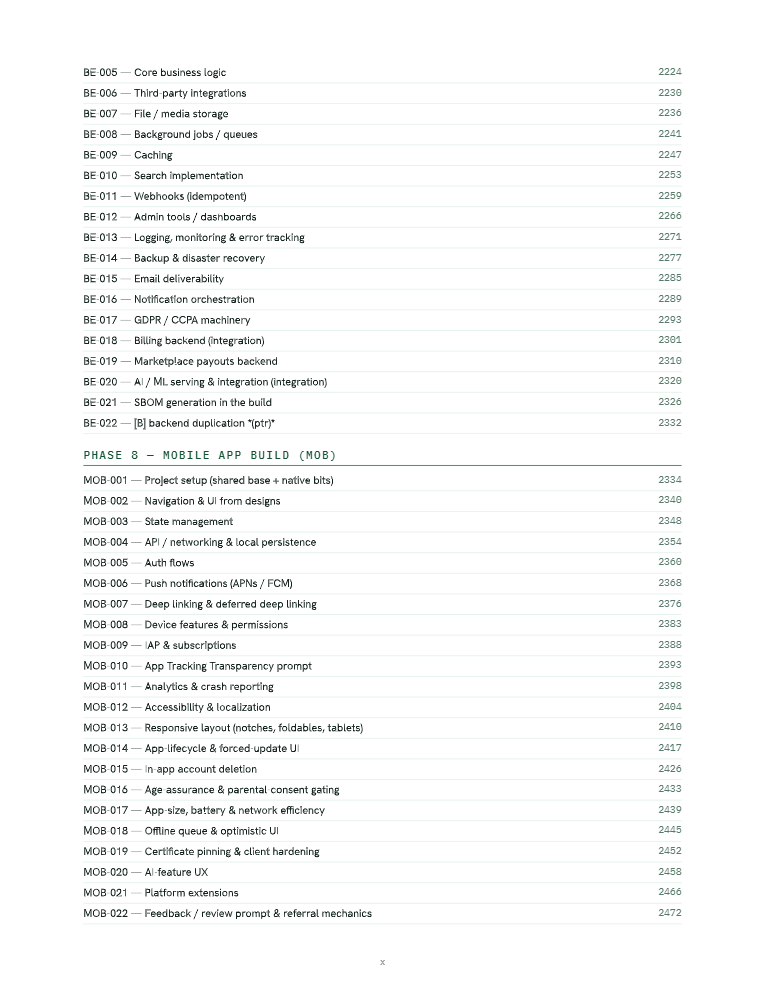
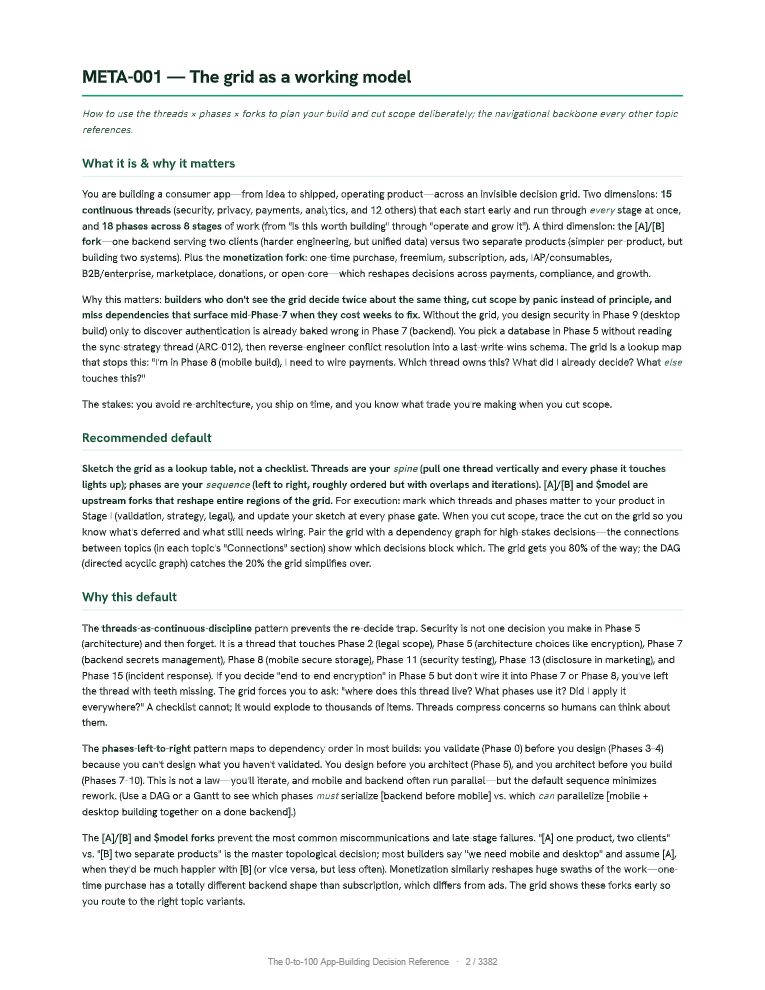
actual pages, current edition · read a whole chapter →
Your agent can write the code. It answers only the questions you think to ask.
And it re-decides differently every chat. The masterclass isone set of verdicts — dated, sourced, reconciled — that your agent holds from empty repo to launch.
How it works
After you wire the agent bundle into your coding agent (Claude Code, Cursor, or any setup that reads project files — about two minutes):
- 1
You know your app idea better than anyone. The reference has your agent ask you the right questions first: what you’re building, one product or two, how it makes money, what your desktop client is. Those answers drive everything downstream.
- 2
Every decision starts from a verdict, adapted to your project. Before your agent picks a framework, a billing channel, or a rollout strategy, it consults the matching topic and gets the recommended default, the reasoning, and the conditions that would flip the call for an app shaped like yours.
- 3
The decisions come in the right order. The reference is a grid of 15 threads across 18 phases, so the choices that block other choices come first. You find out that payments shape your stack before you pick the stack, not after.
- 4
It carries the numbers that matter, verified. Store commissions, program thresholds, framework versions, review policies. Each is checked against primary sources and stamped with the date it was checked, so your agent plans from current facts instead of training-data memory.
- 5
It flags the compliance and store-review traps where they apply. Privacy labels, consent flows, auto-renewal rules, the submission requirements that get first-time apps rejected. Each one sits in the thread where you’d hit it, so it’s handled in the plan instead of discovered in a rejection notice.
- 6
And when you ask “why?”, it shows you. Topic, source, date checked. You’re never left wondering whether your agent made something up. Three months in you say “we shipped the beta, what’s next” and it answers from the same reference instead of inventing a new plan.
What you and your agent decide correctly, the first time
Your agent proposes from the reference’s verdicts; you approve.
A stack decision you can defend
your desktop client decides your mobile stack. The reference makes the call for your shape and writes down what would flip it.
A payments and entitlement plan
store IAP vs. direct billing vs. merchant-of-record, with the real 2026 fee math and the entitlement layer that keeps your options open.
An app-store review pre-flight
the rejection traps checked before you submit, so review is a formality instead of a three-week surprise.
A monetization pick with numbers
subscription, one-time, or ads, chosen against your app's shape, with the pricing mechanics that follow from it.
A privacy and data-safety checklist
the privacy labels, consent steps, and policy documents both stores require, done once and done right.
A security baseline
the credentials, storage, and API decisions that are cheap on day one and expensive to retrofit.
A launch and rollout plan
staged rollouts, a kill switch, and crash monitoring wired in before your first real users arrive.
A growth loop that fits your app
store listing, review prompts, referral mechanics, and the measurement to know which one is working.
The pattern continues across all fifteen threads — security, privacy, accessibility, testing, operations, cost, legal, growth. Each topic makes the call, gives the reasoning, and names what would change it.
Included with every copy
The agent bundle: the reference, in your agent’s native language
The PDF is for you. The agent bundle is the same reference as 389 clean, per-topic markdown files plus a machine-readable index (id, title, thread, tags, one-line verdict, last-verified date) that tells your agent which topic to consult before each decision.
Wire it in once
Drop the bundle next to your project and paste the ready-made snippet from INTEGRATION.md into your agent’s context file. Works with Claude Code, Cursor, or any agent that reads files. About two minutes.
Your agent stops guessing
It consults the matching topic before each build decision and answers from written-down verdicts and checked facts instead of fuzzy memory. Ask it to cite the topic and it will.
The plan stops drifting
Same reference today, same reference at launch. Your architecture stops mutating every time you open a new chat.
Three prompts to try in your first ten minutes:
Before we pick the mobile framework, consult the reference's stack topics and tell me what it recommends for MY app: desktop client is a web app, monetization is subscriptions.
We're adding in-app purchases. Read the reference's payments and entitlement topics, then propose the billing setup for this project with the fee math written out.
Run the reference's app-store review pre-flight against this codebase and give me a prioritized fix list before we submit.
Because your coding agent can touch files, it goes further than advice: it implements what the topic recommends — the project scaffolding, the entitlement layer, the crash reporting, the staged-rollout config — and cites the topic it built from in the commit.
“Can’t I just ask my AI?”
You can, and for single questions you should. Here’s what the chat can’t do, and the reference does:
The questions you didn’t ask
AI answers what you ask. The expensive mistakes are the questions you never asked. The reference hands you the complete question list, in dependency order, with the decisions that block other decisions marked.
The same plan at launch
Forty chats produce forty plans that disagree with each other. One reference, reconciled once, means your agent gives the same answer in October that it gave in July.
Sources you can check
A chatbot sounds equally sure when it’s wrong. Every nontrivial claim in the reference is cited and dated against primary sources, re-verified on cadence, and the reference argues with its own sources: content-farm benchmarks get named and refused, not repeated. The method is public, so you can audit us before paying.
an actual topic header from the reference:
ARC-006 — Mobile stack · Tier: decision · Last-verified: 2026-07-02
An actual answer
“It depends, here are five options” doesn’t help you on a Tuesday afternoon. Every topic leads with the recommended default, then what flips it. You can execute that without being the senior engineer.
a real verdict, from ARC-006:
“Start by answering one question: what is your desktop client? It decides the mobile stack more than any benchmark.”
One wrong stack choice is close to a rewrite. One app-store rejection you didn’t see coming costs weeks. The masterclass is one hundred forty-nine dollars, once, against exactly those mistakes.
What this is not
It won’t write your app for you — your agent does that already. And it can’t promise your app will succeed; nobody honest can. What it does is make sure the 389 decisions you’re about to make anyway — stack, auth, payments, pricing, launch — get made with the research done, instead of by whatever your agent happened to say that day.
- It doesn’t write your code or ship your app unattended. Your agent builds; you decide. The reference makes sure you’re both deciding from the same verified ground.
- It doesn’t know your app until your agent asks you. You know your idea and your constraints; the reference covers the decisions every consumer app shares.
- Technical facts rot. Store fees, review policies, and framework versions move. That’s why every claim is dated, the reference is re-verified on a schedule, and your copy includes every re-verified edition through v2.
Don’t buy this if
- You’ve already shipped three apps — you’ve paid for this knowledge the hard way.
- You want a no-code template — this teaches decisions, not drag-and-drop.
- You’d rather learn by breaking things for a year — respect; that works too.
And the free chapter is genuinely free— read it first and decide there.
Who made this
I’m Sam, and Agent Era Guides is one person — me. No team, no growth hackers, no course-guru machinery — a re-verification schedule and dated sources instead of a personal brand.
Questions before you buy? Email hello@theappmasterclass.com— a person answers. And if the reference isn’t what you needed: email me within 7 days and I’ll refund you. No questions, no form.
— Sam · Agent Era Guides
One purchase. Everything in it.
One hundred forty-nine dollars, once. Weighed against a single wrong stack choice or one store-review rejection, it pays for itself the first time it changes a decision.
- ✓ The agent bundle — all 389 topics as per-topic markdown files, a machine-readable index.json, and INTEGRATION.md with a paste-ready snippet for Claude Code, Cursor, or any coding agent.
- ✓ The PDF — the full reference with cover, page-numbered contents, and complete bookmarks. For reading; the bundle is for building.
- ✓ The packet — the whole reference as a single markdown file with a generated contents, for search and for pasting into anything.
- ✓ The glossary — over a thousand plain-language definitions covering every technical term the reference uses.
- ✓ Every re-verified edition through v2 — when the facts move and we re-check, you get the new edition. (v2 is the next major rebuild; majors ship when the ground has shifted enough to warrant one.)
- ✓ 7-day refund, no questions. Email me and I’ll refund you — no forms, no hoops.
Not sure? Read the free chapter first— it’s the full orientation chapter at full depth, and every topic behind it is built the same way.
Get both guides — The Complete Set. The masterclass + The Modern Marketing Map, $179 together (vs $208 separately).
Get the set — $179The masterclass is one of two agent-era field guides built the same way: this one to build a thing, andThe Modern Marketing Map to market it.
Free checklist
The Agent-Ready Build Checklist
A 17-point, one-page checklist for setting up your app project so a coding agent works fast without wrecking anything. Pulled straight from the reference. Free.
The checklist + occasional updates. No spam, unsubscribe anytime.